
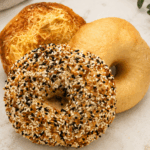
Easy Homemade Sourdough Bagels
- Total Time: 6-7 hours
- Yield: 9 1x
Description
If you’ve been searching for the perfect homemade sourdough bagel recipe, you’ve found it. These naturally fermented sourdough bagels have everything you love about a classic New York-style bagel—a chewy interior, golden crust, and incredible flavor that only sourdough fermentation can provide. Made with active sourdough starter, bread flour, all-purpose flour, and diastatic malt powder, these bagels are perfect for breakfast sandwiches, cream cheese spreads, or simply toasted with butter.
This sourdough bagel recipe is designed for home bakers who want bakery-quality results using simple ingredients and a straightforward process. The overnight cold proof develops deeper flavor while making the dough easier to handle and fit into your schedule.
Equipment Needed
Having the right tools makes sourdough bagel baking much easier and more consistent.
- Digital kitchen scale https://amzn.to/3PX73N6
- Stand mixer with dough hook https://amzn.to/4o9KQrL
- Digital Thermometer https://amzn.to/4xeK3Kg
- Bench scraper https://amzn.to/4esjqcj
- Kitchen timer https://amzn.to/4uLJYvO
- Sheet pans https://amzn.to/3RP2dC2
- Parchment paper (individual 5-inch squares) https://amzn.to/4ojmwnh
- Large shallow pot for boiling https://amzn.to/4uQcUmp
- Slotted spoon or spider strainer https://amzn.to/4dLVPUI
- Chopsticks or tongs for flipping bagels https://amzn.to/4ocbG2q
- Cooling rack https://amzn.to/4ec5qmS
Helpful Recipe Tips
- Your sourdough starter should be at peak activity before mixing your dough. A healthy, active starter will produce lighter, more flavorful bagels with better fermentation.
- Allowing the flour, starter, and water to rest before adding the remaining ingredients helps improve gluten development, dough strength, and overall texture.
- When shaping your bagels, make the center hole larger than you think it needs to be. The dough will expand significantly during final proofing and baking.
- Fermentation times can vary depending on the temperature of your kitchen. Look for a dough that has doubled in size and feels airy rather than relying solely on time estimates.
- Placing shaped bagels on individual parchment squares makes transferring them to the boiling water simple and helps prevent sticking.
- Apply everything seasoning, sesame seeds, Asiago cheese, or your favorite toppings immediately after boiling while the bagels are still warm and tacky.
Recipe Timeline for Success
Evening before
- Feed your sourdough starter. 22g starter: 110g water: 110g flour
When Starter Reaches Peak
- Mix starter, flour, and 330g water.
- Fermentolyse for 30 minutes.
- Add remaining water (20g), salt, and avocado oil.
- Mix until smooth and developed.
- Rest for 1 hour.
- Perform one set of coil folds.
- Continue bulk fermentation until doubled.
Evening
- Divide dough into 150-gram portions for 9 large bagels or 115-gram portions for 12 smaller bagels.
- Shape into tight dough balls.
- Place on parchment squares.
- Cover and refrigerate overnight.
Morning
- Shape bagels by stretching a hole through the center. Over stretch the hole as it will shrink during the second proof.
- Proof at room temperature for 60–90 minutes until puffy.
- Boil in water with barley malt syrup or molasses. 1 minute each side.
- Add toppings.
- Bake at 450°F for 20–25 minutes or until internal temperature is between 205-210 degrees Fahrenheit
Why Use a Kitchen Scale?
A digital kitchen scale is one of the most important tools for successful sourdough baking. Measuring ingredients by weight provides accuracy that measuring cups simply cannot match.
Benefits of using a scale include:
- Consistent hydration every time
- Better fermentation results
- More predictable dough handling
- Improved recipe repeatability
- Less cleanup and fewer dishes
Even small measurement differences can dramatically impact sourdough recipes. Weighing ingredients ensures your bagels turn out the same every time you bake them.
Final Thoughts
These homemade sourdough bagels are one of the most rewarding recipes you can make with your sourdough starter. The combination of a long fermentation, traditional boiling process, and high-temperature bake creates bagels with incredible flavor, beautiful color, and the perfect chewy texture.
Whether you’re making plain, everything, sesame, Asiago, cheddar jalapeño, or cinnamon raisin bagels, this recipe provides a reliable foundation for creating bakery-quality bagels right in your own kitchen. Once you experience the flavor and texture of fresh homemade sourdough bagels, you’ll never look at store bought bagels the same way again.
Ingredients
350g Active Starter
350g Water (reserve 20g for fermentolyse)
350g All purpose flour
350g Bread flour
10g Avocado oil (substitute w/olive, vegetable or canola)
14g Salt
8g Diastatic malt powder https://amzn.to/4o9RLBf
2 Tbls Barley malt syrup https://amzn.to/4uTsii0
Instructions
- Mix starter, flour, and 320g water together in a mixer and mix on medium speed for 5-8 minutes or until the dough smooths out.
- Fermentolyse, let rest for 30 minutes, then add in 20g water, salt and oil and mix for another 5-8 minutes or until dough comes together and is smooth.
- Remove from the bowl and place in a lightly oiled container or bowl and cover for a 1 hour rest.
- Do one set of coil folds and counter ferment until doubled in size.
- Divide dough into 150-gram portions for 9 large bagels or 115-gram portions for 12 smaller bagels.
- Shape into balls with push and pulls and pinch the bottoms closed. Place on 4×4 parchment paper. Cover with plastic wrap and place in the fridge overnight.
- Next day, remove from the fridge, poke a hole in the middle of the dough and gently stretch it out. Make sure to over exaggerate the hole since final proofing and baking will expand it.
- Leave your dough at room temperature for an additional 60-90 minutes, until the dough is puffy.
- Preheat your oven to 450 degrees.
- Fill a large shallow pot with water and add 2 Tbls of barley malt syrup. You can use molasses or honey as an alternative to the barley malt syrup. Bring water to a rolling boil.
- It’s very helpful to have an extra sheet tray ready with parchment paper, chopsticks for flipping the bagels and a slotted spoon for removing the hot bagels from the water.
- Boil 3 bagels at a time by placing the bagel and parchment paper directly into the water. Remove the parchment paper and boiling for 1 minute on each side. Use the slotted spoon to remove and drain the bagels. Place the bagels on a sheet pan with parchment paper.
- Add any toppings (everything seasoning, sesame seeds, minced onion, etc..) you want while the bagels are still warm and sticky. Placing the bagels on parchment squares makes it easier to pick up the bagel to press into the toppings.
- Bake for 20-25 minutes, depending on how dark you want them. Internal temperature should be between 205-210 degrees Fahrenheit.
Notes
- For best results, use an active sourdough starter at peak activity before mixing the dough.
- Fermentation times will vary depending on the temperature of your kitchen. The dough is ready when it has doubled in size and feels light and airy. This recipe has a large amount of starter, therefor, the fermentation will be faster than you may be used to.
- If the dough feels stiff while mixing, resist the urge to add extra water. Bagel dough is naturally lower hydration than bread dough, which creates its signature chewy texture.
- You don’t have to cold proof but it does allow for more flavor to come through.
- Make the center hole larger than you think it needs to be. The dough will expand during the final proof and baking process. You can stretch out the dough again, if needed, after the second proofing.
- Barley malt syrup provides the most traditional bagel flavor, but molasses or honey can be substituted if needed.
- Diastatic malt powder is optional, however, it helps the crust get a better color and the bagels to stay fresher a little longer.
- For a shiny crust, add toppings immediately after boiling while the surface is still tacky.
- Store bagels in an airtight container at room temperature for up to 3 days.
- For longer storage, slice and freeze the bagels for up to 3 months. Toast directly from frozen for a fresh-baked taste.
- Popular topping ideas include everything seasoning, sesame seeds, poppy seeds, Asiago cheese, cheddar cheese, dehydrated onion, dehydrated garlic, cinnamon sugar, or coarse salt.
- Bagels are fully baked when they are deep golden brown and have an internal temperature of 200°F–210°F (93°C–99°C).
- This recipe makes approximately 9 bagels weighing 150 grams each.
- Prep Time: 5-6 hours
- Cook Time: 45 minutes
- Category: Bagels
Nutrition
- Serving Size: 1
- Calories: 367
- Sugar: 1g
- Sodium: 612mg
- Fat: 2g
- Saturated Fat: 0
- Unsaturated Fat: 0
- Trans Fat: 0
- Carbohydrates: 75g
- Fiber: 3g
- Protein: 10g
- Cholesterol: 0